
These are the signs you should know
Tooth decay is one of the most common dental diseases worldwide – and yet it is often detected too late. Many people only think about visiting the dentist once pain occurs. But by then, the condition has often already progressed.
In our dental practice in Ingolstadt, we see it every day: if you detect tooth decay early, you can often avoid more extensive procedures, reduce costs, and preserve your natural teeth for the long term. In this guide, you will learn how tooth decay develops, which early warning signs you should know, and how you can protect yourself effectively.
How does tooth decay develop in the first place?
Tooth decay develops through an interplay of bacteria, sugar, and time. Your mouth contains numerous microorganisms that feed on sugar. In the process, they produce acids that attack the tooth enamel and gradually demineralize it.
At the beginning, this process often goes unnoticed. The tooth enamel is slowly weakened without any pain occurring. This is exactly what makes tooth decay so insidious in the early stages – it develops quietly and gradually. Only when the damage penetrates deeper into the tooth do symptoms such as sensitivity or pain appear.
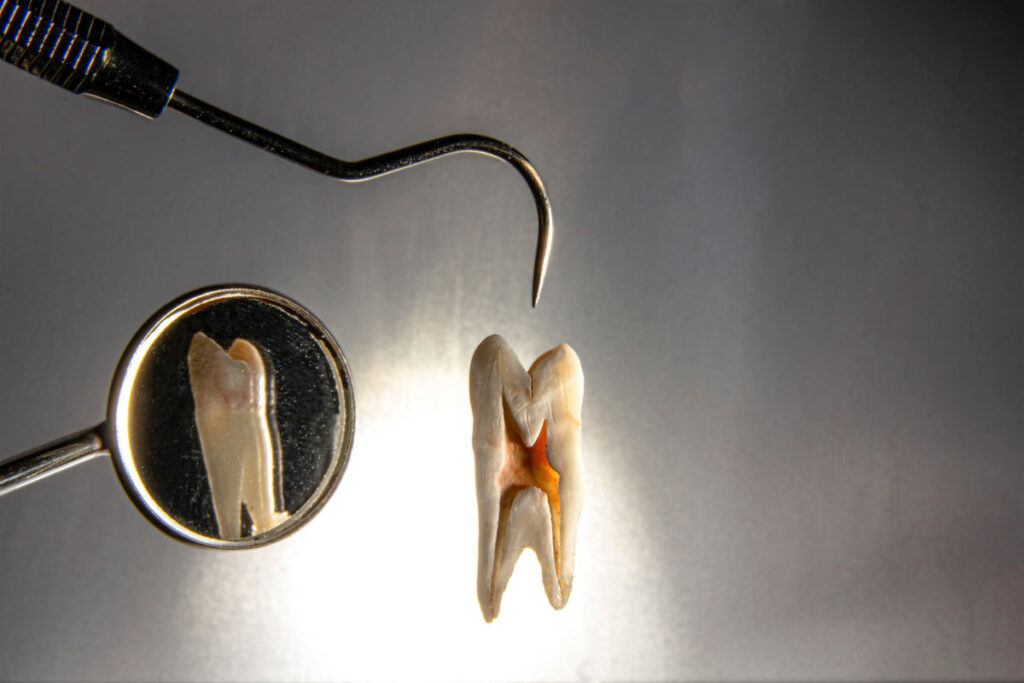
You can picture a tooth as a layered model: the outer layer of enamel is the hardest substance in the body, beneath it lies the softer dentin, and at the core sits the sensitive dental nerve. Tooth decay works its way from the outside in through these layers – and the deeper it advances, the more noticeable and the more involved the treatment becomes.
The most important signs of tooth decay
Tooth decay often announces itself through small changes that are easily overlooked in everyday life. These are the seven warning signs you should know:
White spots on the teeth
A very early sign of tooth decay is so-called “white spots”. They are caused by mineral loss in the tooth enamel and are often only visible on close inspection.
Dark discoloration
Brown or black spots can be an indication that the decay has already progressed further.
Sensitivity to cold or sweet foods
If your teeth suddenly become sensitive to cold or sweet foods, this can be an early warning sign.
Pain when chewing
Pain when biting or chewing often indicates that the decay has already penetrated deeper into the tooth.
Bad breath
The bacteria that cause tooth decay can produce unpleasant odors in the mouth.
Visible holes in the tooth
In advanced stages, tooth decay can become visible as a small hole in the tooth.
Sensitivity to pressure
If a tooth suddenly feels sensitive to pressure, this can be a sign of inflammation inside the tooth.
If you notice one or more of these symptoms, you should see a dentist in Ingolstadt promptly.
Why tooth decay often goes unnoticed
Many patients rely on pain as a clear warning signal. That, however, is a misconception.
In the early stages, tooth decay generally causes no pain. The tooth enamel contains no nerves – which is why the condition often remains undetected for a long time. Symptoms only appear once the inner part of the tooth is affected. By that point, treatment is usually more involved.
An absence of pain is no proof of healthy teeth – the crucial early stages take place entirely without symptoms.
What happens if tooth decay remains untreated?
Untreated tooth decay generally continues to progress. The damage grows and penetrates deeper into the tooth. Possible consequences include:
- Destruction of the tooth enamel
- Decay affecting the dentin
- Inflammation of the dental nerve
- Increasing pain
- The need for root canal treatment
- In the worst case, tooth loss
That is exactly why it makes sense to act early instead of waiting.
How does the dentist detect tooth decay early?
In our dental practice in Ingolstadt, we rely on modern diagnostics to detect tooth decay as early as possible. This includes:
- A visual examination of the teeth
- X-rays
- An analysis of the tooth surfaces
This allows even the smallest changes to be detected and treated before more serious damage occurs.
How is tooth decay treated?
The treatment depends on how far the decay has progressed.
Early stage
As long as only the outermost layer of enamel is demineralized, the tooth can often still be treated without drilling. Targeted fluoride application can remineralize the enamel and harden it again. It is frequently enough to keep a close eye on the affected area and adjust your oral hygiene.
Intermediate stage
If the decay has already formed a small cavity, the damaged tissue is removed and the tooth is restored with a filling. This preserves as much of your natural tooth structure as possible, and the defect is sealed securely again.
Advanced stage
If the decay has reached the dental nerve and inflamed it, root canal treatment may become necessary to preserve the tooth. You can read more about the options for preserving your natural teeth on our page about tooth preservation.
How can you prevent tooth decay?
The best treatment is prevention. With a few habits, you can support your dental health in everyday life:
- Brush your teeth thoroughly twice a day
- Clean between your teeth regularly
- Reduce your sugar consumption
- Keep regular dental appointments
A combination of good oral hygiene and professional care is essential. The spaces between the teeth, in particular, are often neglected in everyday life – yet this is where tooth decay begins especially frequently, because the toothbrush cannot reach them. Daily flossing or interdental brushes close exactly this gap.
Practice tip: do not brush immediately after eating
After acidic foods or drinks, the tooth enamel is temporarily softened. Wait about 30 minutes before reaching for your toothbrush – this way you do not wear away an already attacked layer of enamel. A sip of water or sugar-free chewing gum can help stimulate saliva flow in the meantime.
Why regular check-ups are so important
Many problems arise because appointments are postponed for too long. Regular check-ups make it possible to detect changes early and treat them easily, while the effort involved is still low.
Tooth decay in children and adults
Tooth decay can occur at any age, though often for different reasons. In children, a sugary diet often plays a role; in adults, it is frequently plaque in hard-to-reach areas. In both cases, the same applies: the earlier changes are noticed, the more gently they can be treated.
Conclusion: early detection protects your teeth
Tooth decay is a condition that develops gradually but can have noticeable consequences. If you know and take the first signs seriously, you can often avoid more extensive treatment.
If you are unsure or notice any of the symptoms mentioned, we recommend an appointment with your dentist in Ingolstadt. Because healthy teeth begin with attention – not with pain.